
If you’re thinking about switching to a blue steel pan but aren’t sure what you’re getting into, this page is for you. Whether you’re a carbon steel pan beginner or just researching before you buy, these are the questions we hear most often — answered as directly as possible.
1. Is a Blue Steel Pan Easy to Use for Beginners?
Honest answer: it depends on what you’re comparing it to.
Compared to a nonstick pan, there’s an adjustment period. A blue steel pan for beginners requires a bit more attention — it isn’t as forgiving straight out of the box — it needs to be seasoned, it needs to be preheated properly, and the first few weeks of cooking with it will feel different from what you’re used to.
Compared to cast iron or stainless steel, most people find it very manageable. It’s lighter than cast iron, heats up faster, and responds to temperature changes more quickly — which actually gives you more control once you get used to it.
The key thing to understand is that is a blue steel pan easy to use comes down to consistency — the more you cook with it, the easier it gets. Most people who stick with it through the first few weeks find that it becomes their most-used pan.
2. How Long Does It Take to Fully Break In?
There’s no fixed answer, because it depends on how often you use the pan. For a blue steel pan for beginners, here’s a realistic timeline:
- First 3 seasoning rounds — the pan is ready to cook with, but will still stick with delicate foods like eggs
- First 2–4 weeks of regular use — the seasoning builds noticeably, the surface darkens, and sticking becomes less frequent
- 1–2 months of consistent cooking — most people find the pan is performing reliably at this point, and eggs become much more manageable
The faster you get there is by using it regularly — several times a week, with oil-rich foods like meat and vegetables. Every cook adds another layer to the seasoning. A pan that sits unused doesn’t improve.
3. Why Is My Pan Turning Black — Is That Normal?
Completely normal, and actually a good sign.
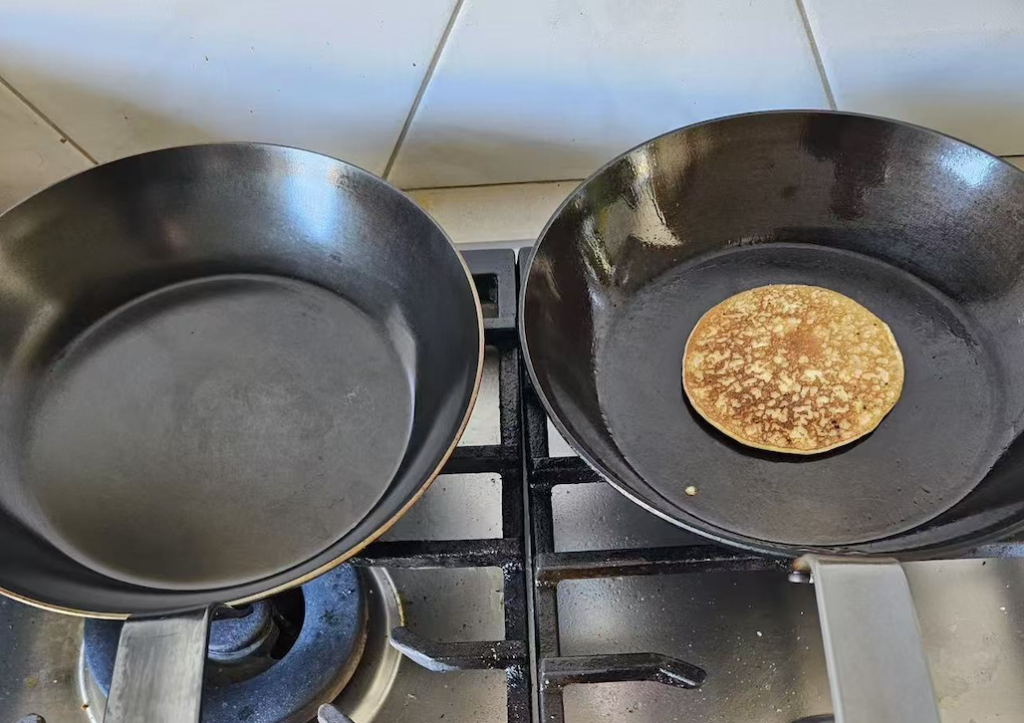
The colour change happens in two stages. First, the blue-grey surface from the factory darkens as the seasoning builds. Over time, with regular use, the pan turns brown, then dark brown, and eventually close to black. That black surface is what you’re aiming for — it means the seasoning layers have developed and the pan is at or near its best performance.
The colour doesn’t need to be perfectly uniform. Patchy colouring is a normal part of how carbon steel develops, and it evens out with continued use. If your pan looks a bit uneven, keep cooking with it — it’s part of the process, not a problem.
4. Can I Use Soap to Clean It?
The short answer is: avoid it for regular cleaning.
Soap — especially strong detergent — can strip the seasoning layer you’ve worked to build up, leaving the surface more prone to sticking and rust. For everyday cleaning, warm water and a soft brush or sponge is enough. If something is stuck, a bit of coarse salt works well as a gentle abrasive.
That said, the occasional light use of mild soap won’t ruin the pan. If you’ve cooked something particularly stubborn, a small amount of soap is fine — just re-apply a thin coat of oil afterwards and the seasoning will recover quickly.
5. Is It Safe to Cook With — No Coating Concerns?
This is one of the most common questions, and for a blue steel pan, the answer is straightforward: yes.
A blue steel pan has no synthetic coating of any kind. The surface is just steel — heat-treated to form a dense iron oxide layer, then built up through seasoning with natural oils. There’s no PTFE, no PFAS, no ceramic coating. Nothing that can chip, flake, or degrade into your food.
This is actually one of the main reasons people switch to carbon steel. As regulatory bodies in the US and Europe move toward stricter guidelines on PFAS in cookware, a coating-free pan removes the question entirely. Blue steel pan safe cooking comes down to the same thing it always has — heat, oil, and good technique.
6. Can I Use It on Induction?
Yes — a blue steel pan works on induction stovetops. Carbon steel is magnetic, so it’s fully compatible with induction.
One thing worth noting: induction and ceramic stovetops are not ideal for the initial seasoning process. These heat sources concentrate heat in the centre of the pan, which can cause uneven temperature distribution and occasionally lead to the base warping slightly. For the first few rounds of seasoning, a gas stove gives more even results.
Once the pan is seasoned and you’re using it for regular cooking, induction works well.
7. Is It Lighter Than Cast Iron?
Yes, noticeably so. This is one of the practical advantages of a blue steel pan that often gets overlooked — especially for a carbon steel pan beginner who’s coming from cast iron.
A blue steel pan is significantly lighter than cast iron equivalents of the same size. In terms of carbon steel pan weight, a comparable blue steel pan typically weighs around 1.5–2kg — compared to 3–4kg for a 28cm cast iron pan. That difference matters when you’re moving a pan around the stove, transferring it to the oven, or just lifting it with one hand to plate a dish.
Carbon steel also heats up and cools down faster than cast iron, which means more responsive heat control — useful when you need to turn down the temperature quickly or finish cooking off the heat.
8. Is It Worth Switching From Nonstick?
For anyone who cooks regularly — yes, in most cases.
The trade-off is this: a nonstick pan is easier on day one. A blue steel pan is better on day 300. Nonstick pans degrade over time, need replacing every year or two with heavy use, and have limitations around high heat and oven use. A well-maintained blue steel pan improves with use, lasts indefinitely, and handles high-heat cooking that nonstick simply can’t.
Is a carbon steel pan worth it? If you cook often, care about what your cookware is made of, and want something that gets better rather than worse over time — then yes, it’s worth the adjustment period. If you cook occasionally and want minimal effort, a nonstick pan might still be the right choice.
The honest answer is that most people who make the switch don’t go back.
Final Thoughts
A blue steel pan does have a learning curve — it asks more from you than a nonstick pan, and that’s worth being honest about. But is a blue steel pan easy to use? Yes, once you know the basics. Season it properly, follow the basic care steps, and cook with it regularly. That’s really all it takes. Most people who stick with it find that the adjustment period is shorter than expected — and the pan they end up with is one they reach for every day.
Part of our blue steel pan guide: