
Stainless steel cookware may look similar from the outside, but the construction underneath can be very different.
Two common options are full clad cookware and capsule bottom cookware. Both can combine stainless steel with a heat-conductive core. Aluminum is the most common choice, while some capsule bottoms use copper or a combination of conductive metals. The main difference is where that conductive core is located.
In full-clad cookware, the bonded layers extend through the base and side walls. In capsule bottom cookware, the heat-conductive layers are concentrated in a separate disc attached to the bottom.
This difference affects heat distribution, weight, production cost and product positioning. However, it does not mean that one construction is suitable for every project. The right option depends on the cookware shape, intended use, target retail price and market expectations.
What Is Full-Clad Cookware?
Full-clad cookware is made from a bonded multi-layer sheet that forms the entire cookware body. The layers normally extend from the center of the base, through the side walls and up to the rim.
A common tri-ply structure is:
- Inner layer: 304 stainless steel for food contact
- Middle layer: aluminum for heat transfer
- Outer layer: magnetic 430 stainless steel for induction compatibility
The aluminum core carries heat beyond the bottom and into the side walls. This can help the cookware heat more evenly across the whole body, especially in frying pans, sauté pans, and shallow casseroles.
The term full-clad describes the coverage of the bonded material. It does not automatically confirm the number of layers, the thickness, the stainless steel grades or the type of cooking surface. A full-clad body may have a polished or brushed uncoated interior, a PTFE or ceramic coating, or a honeycomb surface. These specifications should be checked separately.
For a closer look at the cooking surface, read our guide to how honeycomb tri-ply cookware works.
An uncoated full-clad stainless steel frying pan should not be described as a conventional non-stick pan. It requires proper preheating, temperature control and a small amount of oil for better food release. Similarly, a honeycomb appearance alone does not prove that a product is fully clad. A honeycomb pan may use a full-clad body, a capsule bottom or another construction.
What Is Capsule Bottom Cookware?
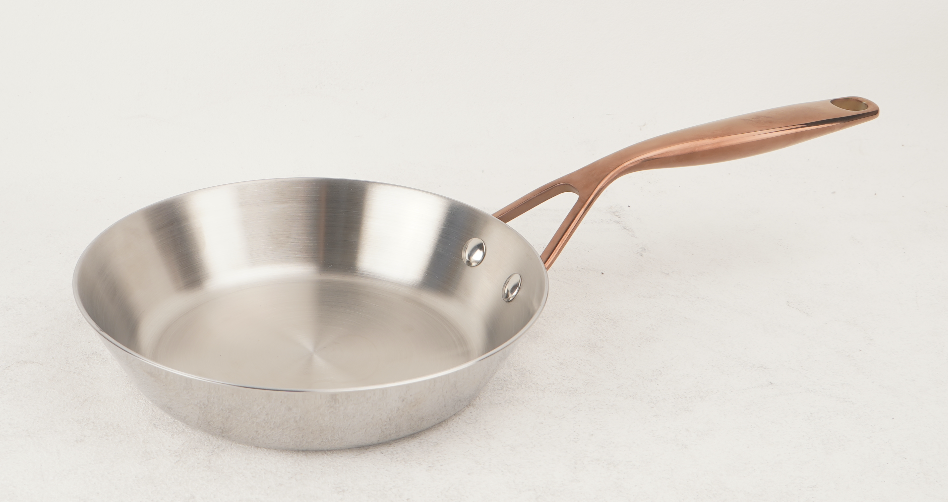
Capsule bottom cookware usually has a single-layer stainless steel body with a separate multi-layer disc attached to the base.
The bottom structure often includes:
- The stainless steel body of the cookware
- An aluminum or copper core for heat distribution
- A magnetic stainless steel outer plate for induction use
The core and outer plate may be attached by impact bonding or another bonding process. The outside plate encloses the conductive core, which is why this construction is also called an encapsulated bottom or sandwich bottom. Many capsule bottoms are impact-bonded, but buyers should still confirm the actual bonding method.
Aluminum is widely used because it offers a practical balance of heat transfer, weight and cost. Copper transfers heat efficiently and is used in some higher-positioned products, but it normally increases material cost. Some base structures also combine aluminum and copper rather than using only one core material.
Most of the heat-spreading material is limited to the base. The side walls remain mainly single-layer stainless steel and therefore do not conduct heat in the same way as a full-clad body.
Capsule bottom cookware should not automatically be treated as poor-quality cookware. A properly designed impact-bonded base can be durable and perform well, particularly for boiling, steaming and other cooking tasks that depend mainly on bottom heat.
Full-Clad vs. Capsule Bottom Cookware: Quick Comparison
| Factor | Full-Clad Cookware | Capsule Bottom Cookware |
|---|---|---|
| Construction | Bonded layers extend through the base and side walls | Conductive layers are concentrated in a separate bottom disc |
| Heat distribution | Heat can spread across the base and into the side walls | Heat is mainly distributed across the base |
| Heating response | Often more responsive across the whole body | Depends heavily on core material, disc thickness and diameter |
| Weight | Commonly heavier than a thin single-wall body, but varies by thickness | Can be lighter or heavier depending on the bottom disc |
| Induction | Compatible when the exterior layer is magnetic | Compatible when the outer bottom plate is magnetic |
| Durability focus | Bonding quality, rim finishing and body flatness | Disc bonding, centering, edge sealing and base flatness |
| Production cost | Usually higher because composite material covers the full body | Usually more cost-effective for entry and mid-range products |
| Typical positioning | Mid-range, premium and professional cookware | Entry-level, value retail and general-purpose cookware |
How the Construction Changes Heating Performance
1. Heat Distribution Across the Base
Both constructions can distribute heat well across the bottom when they use a sufficiently thick and properly bonded conductive core.
A capsule bottom with a wide, well-bonded aluminum or copper core may perform very well. If the disc is too small, however, the area near the outer edge of the base may heat differently from the center.
In full-clad cookware, the aluminum layer is part of the complete body. There is no separate step between the base and side-wall material, which supports more continuous heat movement through the pan.
2. Heat Transfer Through the Side Walls
This is the main performance difference.
The aluminum core in full-clad cookware continues into the side walls. This is useful when food touches or cooks close to the sides, such as when reducing a sauce, braising, sautéing or cooking in a shallow casserole.
With capsule bottom cookware, the stainless steel side walls receive heat mainly from the hot base and from the food inside. For boiling or steaming, this may be sufficient. For more temperature-sensitive cooking, the difference can be more noticeable.
3. Heat Response and Retention
Full-clad cookware is often described as more responsive, but the result still depends on the total thickness and the thickness of the aluminum core.
A thick capsule bottom may take longer to heat and cool, but it can also provide useful heat retention. A thinner full-clad body may respond faster, while a thicker full-clad body can provide greater stability and heat retention.
For buyers, the construction name alone is therefore not enough. Thickness, finished weight and intended cooking use should be evaluated together.
Durability and Quality-Control Differences
Both constructions can be durable when the materials and processes are properly controlled. However, the main quality risks are different.
Full-Clad Cookware
Important control points include:
- Consistent bonding between the stainless steel and aluminum layers
- Stable base flatness after forming and heating
- Clean rim finishing without sharp edges or uneven layer exposure
- Consistent wall thickness and cookware shape
- Controlled polishing without excessive material removal
Full-clad cookware does not use a separate bottom disc, so there is no disc-to-body joint. However, poor-quality clad material or incorrect forming can still lead to internal bonding problems, warping or uneven edges.
Capsule Bottom Cookware
Important control points include:
- Correct bottom disc diameter and thickness
- Accurate centering of the disc
- Complete bonding between the disc and cookware body
- No internal gaps or loose areas
- Smooth edge finishing around the capsule
- Stable base flatness after bonding and heating
A properly impact-bonded bottom can remain stable during normal use. Problems are more likely when the bonding area, pressure, material preparation or base design is not properly controlled.
Weight and Handling
Full-clad cookware is often assumed to be heavier, but this is not always true.
A full-clad pan uses multi-layer material across the whole body, which normally adds weight compared with a thin single-layer stainless steel body. However, a capsule bottom can also be heavy when it uses a thick or oversized base disc.
Buyers should therefore compare the finished product weight, not only the construction name.
Weight is especially important for:
- Large frying pans and woks
- Products with heavy cast stainless steel handles
- Cookware aimed at consumers who prefer lighter handling
- E-commerce programs where shipping cost matters
- Cookware sets with multiple large pieces
A slightly thinner full-clad structure with a hollow stainless steel handle may provide a better balance than a thick body combined with a heavy solid-cast handle.
Cost and Market Positioning
Full-clad cookware normally costs more because the composite material extends through the complete cookware body. Material preparation, forming, rim finishing and polishing can also require tighter control.
Capsule bottom cookware is often more cost-effective because the heat-distribution material is concentrated where most heating takes place: the bottom. Aluminum-core versions are generally the more economical choice. Copper-core or aluminum-and-copper structures may be positioned at a higher level and can reduce part of this cost difference.
However, construction is only one part of the final price. Other important cost factors include:
- Total body thickness and heat-conductive core material
- Stainless steel grade
- Handle type method (Hollow stainless steel or cast stainless steel)
- Stainless steel or glass lid
- Polished, brushed or coated finish
- Coating brand
- Packaging and testing requirements
- Order quantity
For an entry-level supermarket program, capsule bottom cookware may offer a practical balance between induction compatibility, acceptable heating performance and retail price.
For a mid-range or premium collection, full-clad cookware provides a clearer construction story and stronger differentiation from conventional stainless steel cookware.
What B2B Buyers Should Confirm Before Quotation
To compare quotations correctly, buyers should confirm the following information:
- Is the cookware fully clad or fitted with a separate capsule bottom?
- What are the inner, core and outer materials?
- What is the total body thickness?
- For capsule bottoms, what are the core material, disc diameter, thickness and bonding method?
- Is the product compatible with induction cooktops?
- What is the finished weight, including the handle and lid?
- Is the cooking surface uncoated, PTFE-coated, ceramic-coated or honeycomb-patterned?
- What flatness, handle-strength and heating tests will be applied?
Using the same product diameter and appearance does not guarantee a valid price comparison. Two pans may look nearly identical while using different material thicknesses, base structures, handles and surface treatments.
Construction is only one part of product selection. Buyers should also consider thickness, weight, coating, handle design and target price. Our guide on how to choose honeycomb tri-ply cookware explains these factors in more detail.
Frequently Asked Questions
Is capsule bottom cookware tri-ply?
A capsule bottom may contain three or more layers in the base. However, the complete cookware body is not fully clad because the layered structure does not extend through the side walls.
Does full-clad cookware always work on induction?
No. Induction compatibility depends on whether the exterior layer is magnetic. A common induction-compatible tri-ply structure uses 304 stainless steel inside, an aluminum core and magnetic 430 stainless steel outside.
Is full-clad cookware always heavier?
No. Full-clad cookware commonly uses more composite material across the body, but the final weight depends on thickness, diameter, depth, handle and lid. A thick capsule bottom can also add substantial weight.
Can a capsule bottom separate from the cookware body?
A properly produced impact-bonded bottom can be durable. Separation, loose areas or internal gaps are quality risks when bonding conditions, material preparation or base design are poorly controlled.
Which construction is better for a frying pan?
Full-clad construction is generally more suitable when even heating across the base and side walls is important. Capsule bottom construction can still be used for value-oriented frying pans when the base disc has sufficient coverage, thickness and flatness.
Which construction is more suitable for a cookware set?
It depends on the target price and product positioning. A premium set may use full-clad construction throughout. A value-oriented set may use capsule bottoms, while some programs combine full-clad frying pans with capsule-bottom stockpots or steamers.
Final Thoughts
Full-clad and capsule bottom cookware are designed for different product goals.
Full-clad construction carries the conductive core through the base and side walls. It is particularly useful for frying, sautéing, sauces and shallow cooking, and it supports a stronger mid-range or premium product position.
Capsule bottom cookware concentrates the conductive material at the base. It can provide reliable performance at a more accessible cost, especially for boiling, steaming, stockpots and value-focused retail programs.
For B2B buyers, the best choice is not simply the construction with the higher price. It is the construction that matches the cookware shape, cooking function, target consumer, retail channel and required price point.
Planning a Stainless Steel Cookware Collection?
If you are developing an OEM or private-label cookware line, share your target market, cookware types, preferred specifications and price positioning with us. We can help you compare full-clad and capsule bottom options, recommend a suitable construction and prepare a quotation based on your program.
Contact us to discuss the right stainless steel cookware solution for your market.