
Honeycomb cookware has become increasingly visible in the global cookware market. Its hexagonal or mesh-like cooking surface looks different from both conventional stainless steel cookware and smooth non-stick pans.
It is often described as hybrid cookware because it aims to combine the durability and browning ability of stainless steel with the easier food release of non-stick cookware.
But what is happening beneath the pattern? Is every honeycomb pan made from tri-ply stainless steel? Does the cooking surface always contain a coating? And is honeycomb cookware really non-stick?
The short answer is that the honeycomb cooking surface and the tri-ply body perform two different jobs:
- The honeycomb surface affects food contact, coating protection, food release and browning.
- The tri-ply body controls how quickly and evenly heat moves through the base and side walls of the cookware.
Understanding this distinction helps brand owners and importers compare specifications more accurately and select the right construction for their target markets.
What Is Honeycomb Cookware?
Honeycomb cookware is cookware with a raised stainless steel pattern across part or all of its cooking surface. The pattern may be hexagonal, mesh-like, circular or another geometric design.
In a common coated hybrid construction, the raised stainless steel areas sit above recessed areas containing non-stick coating. This creates two types of contact on the same cooking surface:
- The raised stainless steel sections contact parts of the food and help protect the recessed coating from direct scraping.
- The coated valleys help reduce sticking and make the pan easier to clean than a completely uncoated stainless steel pan.
This combination is why honeycomb cookware is also commonly called hybrid cookware, hybrid stainless steel cookware or honeycomb non-stick cookware.
However, “honeycomb” describes the cooking-surface design rather than one universal material or production method.
Different manufacturers may create the pattern by embossing, pressing, etching or applying a stainless steel mesh. Pattern height, density, coverage and forming process can vary considerably.
Honeycomb and Tri-Ply Do Not Mean the Same Thing
Honeycomb and tri-ply are related features, but they do not describe the same part of the cookware.
| Term | What it describes | Main function |
|---|---|---|
| Honeycomb | The pattern and material arrangement on the cooking surface | Influences food contact, coating protection, food release and browning |
| Tri-ply | Three bonded metal layers forming the cookware body | Transfers and distributes heat while providing strength and cooktop compatibility |
A pan can have a honeycomb surface without having a fully clad tri-ply body. For example, it may use:
- A coated aluminum body
- A stainless steel body with an impact-bonded base
- A disc-bottom structure
- Another type of multilayer material
Likewise, traditional tri-ply stainless steel cookware can have a completely smooth and uncoated cooking surface.
A visible honeycomb pattern therefore does not automatically mean that the whole pan is made from tri-ply material. Buyers should check the cookware body and cooking-surface specifications separately.
What Are the Three Layers in Tri-Ply Cookware?
You may also see tri-ply cookware written as 3-ply cookware or triply cookware.
“Tri-ply” means that three metal layers are permanently bonded together to form the body of the cookware.
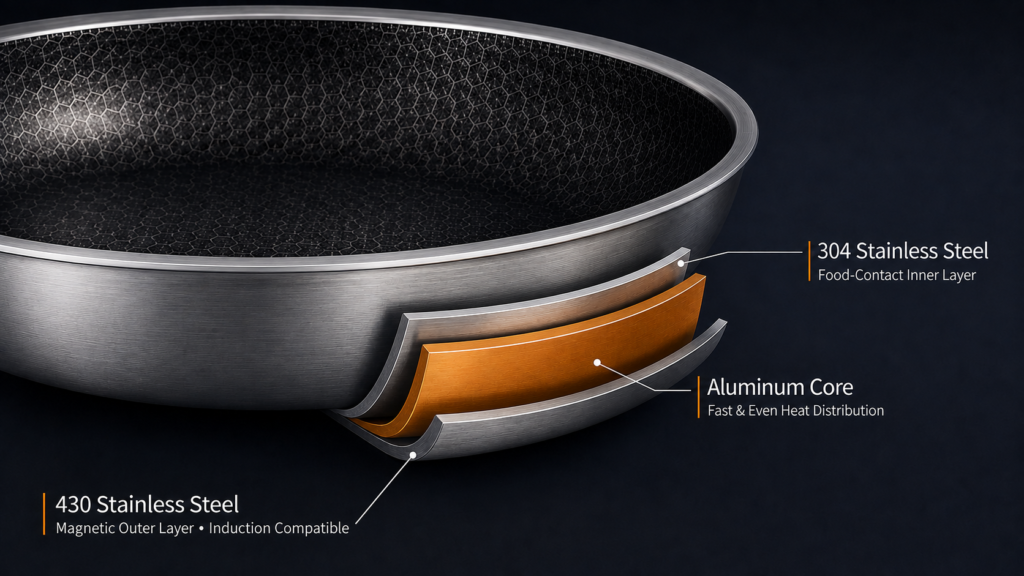
A common construction for induction-compatible honeycomb tri-ply cookware is:
304 stainless steel interior + aluminum core + 430 stainless steel exterior
Each layer performs a different function.
1. Inner Layer: 304 Stainless Steel
The inner food-contact layer is commonly made from 304 stainless steel.
304 stainless steel contains chromium and nickel and is widely used for cookware because it provides:
- Good corrosion resistance
- Good resistance to acidic and alkaline foods
- A durable food-contact surface
- Good formability during production
- A stable base for creating the honeycomb pattern
It is also commonly described commercially as 18/10 stainless steel, referring approximately to its chromium and nickel content.
In coated honeycomb cookware, the raised stainless steel pattern and recessed non-stick areas are formed on or added to this inner layer.
Using 304 stainless steel for the interior is important because this is the layer that comes into direct or partial contact with food.
2. Middle Layer: Aluminum Core
The middle layer is made from aluminum.
Stainless steel is strong and durable, but it does not conduct heat as quickly or evenly as aluminum. The aluminum core is therefore responsible for much of the cookware’s heat distribution and temperature responsiveness.
Its main functions are to:
- Transfer heat more quickly than stainless steel alone
- Spread heat across the base
- Reduce severe hot spots
- Carry heat into the side walls in fully clad cookware
- Help the pan respond more quickly to temperature adjustments
The thickness of the aluminum core is an important part of the cookware specification.
Two pans may both be called tri-ply cookware but perform differently if they use different aluminum thicknesses or layer ratios.
A very thin aluminum core may reduce the expected heating advantage. A thicker aluminum core can improve heat distribution and thermal stability, but it may also increase material cost and overall product weight.
3. Outer Layer: 430 Stainless Steel
The exterior layer is commonly made from 430 stainless steel.
430 stainless steel is ferritic and magnetic. This magnetic property allows the cookware to work on induction cooktops.
The outer 430 stainless steel layer provides:
- Induction compatibility
- Structural support
- Protection for the aluminum core
- A durable stainless steel exterior
This construction can make the cookware suitable for induction, gas, electric and ceramic cooktops without requiring a separate impact-bonded induction disc.
However, induction performance still depends on factors such as the magnetic properties of the material, base diameter, base flatness and compatibility with the particular induction cooker.
Fully Clad vs Disc-Bottom Construction
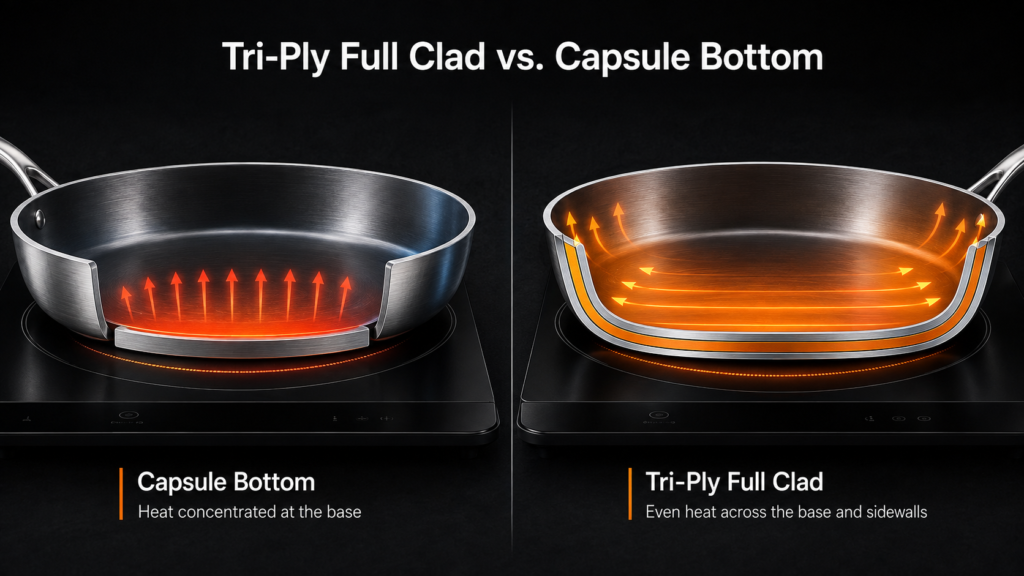
In fully clad tri-ply cookware, all three layers extend continuously from the base to the rim.
This means that the aluminum core distributes heat through both the bottom and side walls of the pan.
This differs from conventional stainless steel cookware with a separate aluminum and stainless steel disc attached only to the bottom. A disc-bottom pan can still distribute heat effectively across its base, but its side walls do not contain the same continuous aluminum core.
It is also important not to assume that every tri-ply pan uses exactly the same materials.
Some manufacturers may use different stainless steel grades, core materials or layer ratios. Brand owners and importers should therefore confirm the grade and thickness of each layer rather than relying only on the term “tri-ply.”
How Does Honeycomb Cookware Work?
In coated honeycomb tri-ply cookware, the tri-ply body and hybrid cooking surface work together.
1. The Aluminum Core Transfers and Distributes Heat
The bonded aluminum core carries heat across the base and, in fully clad cookware, into the side walls.
Because aluminum conducts heat much faster than stainless steel, it helps the cookware heat more quickly and respond faster to temperature adjustments than single-layer stainless steel cookware.
It also helps reduce severe hot spots and provides more consistent heating across the cooking surface.
The honeycomb pattern itself is not the main reason the pan conducts or distributes heat. These characteristics depend more heavily on:
- Aluminum core thickness
- Thickness of the stainless steel layers
- Overall body thickness
- Product size and weight
- Quality of the bonding process
The honeycomb surface and tri-ply body should therefore be evaluated as two separate systems.
2. Raised Stainless Steel Helps Protect the Coating
The raised stainless steel pattern sits above the recessed coated areas.
When a spatula or piece of food moves across the cooking surface, part of the direct contact occurs with the stainless steel peaks rather than only with the coating.
This design can reduce direct abrasion on the recessed coating and provide more protection than a smooth coating that is fully exposed.
However, the stainless steel pattern does not make the coating indestructible.
Its actual durability still depends on:
- Pattern height and consistency
- Coating quality
- Coating adhesion
- Utensil shape
- Cooking temperature
- Cleaning method
- Frequency of use
3. Recessed Coating Helps Food Release
In many honeycomb non-stick cookware products, the recessed areas contain a non-stick coating.
Depending on the product specification, this may be:
- A PTFE-based non-stick coating
- A ceramic non-stick coating
- Another type of release coating
The coating helps reduce food adhesion and makes cleaning easier.
However, because part of the cooking surface remains exposed stainless steel, honeycomb cookware normally does not feel exactly the same as a smooth, fully coated aluminum non-stick pan.
Some foods may still require:
- Proper preheating
- A small amount of oil
- Controlled cooking temperature
- Enough time to brown before turning
4. Exposed Stainless Steel Contributes to Browning
The raised stainless steel areas create points of direct metal contact.
With appropriate heat and a dry food surface, these areas can contribute to browning and searing, while the coated recesses help with food release.
This balance—rather than perfect non-stick performance—is the central idea behind honeycomb cookware.
Does All Honeycomb Cookware Have a Coating?
No. The term “honeycomb cookware” is used broadly in the market.
Some products have raised stainless steel peaks with non-stick coating in the valleys. Others have an embossed texture over a continuous coating. There are also uncoated stainless steel pans with a honeycomb-like texture.
You cannot confirm whether a pan contains a coating simply by looking at its pattern.
Before selecting a product, buyers should confirm:
- Is the cooking surface coated or uncoated?
- What type of coating is used?
- Is the coating continuous or mainly located in the recessed areas?
- How is the stainless steel pattern created?
- Does the pattern cover only the base?
- Does the pattern extend up the side walls?
- Is the body fully clad tri-ply or only disc-bottomed?
These details should be clearly stated in the product specification.
A general description such as “stainless steel honeycomb surface” is not enough to identify the complete construction.
Is Honeycomb Cookware Really Non-Stick?
Coated honeycomb cookware offers non-stick assistance, but it should not automatically be treated as completely non-stick under every cooking condition.
Compared with uncoated stainless steel cookware, it can provide easier food release and simpler cleaning.
Compared with a smooth conventional non-stick pan, however, the exposed stainless steel pattern creates more direct food-to-metal contact.
Its actual non-stick performance depends on:
- Coating type and quality
- Ratio of exposed steel to coated area
- Pattern height and consistency
- Cooking temperature
- Preheating time
- Amount of oil used
- Type and condition of the food
Eggs, fish and starch-rich foods are particularly sensitive to surface temperature and oil coverage.
For this reason, hybrid non-stick cookware is a more accurate description than claiming that nothing will ever stick.
For brand owners, clear product instructions and realistic packaging claims are important. Overstating non-stick performance can create incorrect consumer expectations and unnecessary after-sales complaints.
Benefits of Honeycomb Tri-Ply Cookware
Faster and More Even Heat Distribution
One of the main advantages of honeycomb tri-ply cookware comes from its aluminum core.
Aluminum conducts heat much faster than stainless steel. When it is bonded between the inner 304 stainless steel and outer 430 stainless steel layers, it helps transfer heat quickly across the base and side walls of the cookware.
Compared with single-layer stainless steel cookware, a well-designed tri-ply body can:
- Heat up more quickly
- Respond faster to temperature adjustments
- Distribute heat more evenly
- Reduce severe hot spots
- Provide more consistent heating across the cooking surface
This construction gives the cookware the durability and appearance of stainless steel while improving its thermal performance.
However, actual heating speed still depends on the aluminum core thickness, total body thickness, product weight and cookware size.
Tri-ply cookware should therefore not automatically be described as heating faster than aluminum cookware. The faster and more even heating described here is primarily a comparison with stainless steel cookware without a conductive aluminum core.
This thermal performance comes mainly from the aluminum core—not from the honeycomb pattern itself.
A Balance Between Food Release and Browning
The coated recesses help food release, while the raised 304 stainless steel pattern provides direct metal contact for browning.
This gives honeycomb cookware a clear position between smooth non-stick cookware and fully uncoated stainless steel.
For cookware brands, this hybrid performance can create a strong product story for consumers who want easier cooking without moving completely away from stainless steel.
More Protection for the Recessed Coating
The raised stainless steel pattern can reduce direct contact between utensils and the recessed coating.
This may improve resistance to everyday abrasion compared with a smooth coating that is fully exposed.
However, coating life still depends on the full product construction, coating system, pattern consistency and how the cookware is used.
Induction-Compatible Construction
The magnetic 430 stainless steel exterior allows properly designed honeycomb tri-ply cookware to work on induction cooktops.
The same product can also be suitable for gas, electric and ceramic cooktops, subject to the individual specification.
This all-cooktop compatibility can simplify product positioning and reduce the need to develop separate versions for different cooking systems.
A Distinctive Premium Appearance
The geometric cooking surface is visually recognizable and can help a cookware collection stand apart at retail.
Compared with conventional smooth non-stick pans, honeycomb cookware can offer a stronger premium appearance and a more technical product story.
The pattern, handle, exterior finish, lid, logo and packaging can also be coordinated for private-label development.
A Potential Upgrade From Conventional Non-Stick Cookware
Honeycomb tri-ply cookware can provide an upgrade path for brands that already sell aluminum non-stick cookware but want to introduce a more premium collection.
Its key selling points may include:
- Stainless steel appearance
- Fully clad construction
- Faster and more even heat distribution than single-layer stainless steel
- Hybrid cooking performance
- Better protection for recessed coating
- Induction compatibility
- Higher perceived value at retail
Limitations of Honeycomb Tri-Ply Cookware
Honeycomb tri-ply cookware also involves trade-offs that should be considered during product development.
- It is not identical to a smooth non-stick pan. Delicate foods may still need oil and careful temperature control.
- It is usually heavier than aluminum non-stick cookware. This can improve stability but may not suit markets that prioritize lightweight products.
- It normally costs more to produce. Clad material, pattern processing and coating add production steps.
- The coating is still a consumable surface. Raised steel may protect it, but no coated cooking surface should be expected to last forever.
- Textured surfaces may retain residue. Oil and food particles can collect around the pattern if the pan is overheated or not cleaned properly.
- Quality varies considerably. A visible honeycomb pattern does not confirm good bonding, sufficient aluminum thickness, a reliable coating or a stable base.
These limitations do not make the construction unsuitable. They simply need to be reflected accurately in product positioning, packaging claims, user instructions and warranty expectations.
Honeycomb Tri-Ply vs Uncoated Stainless Steel vs Aluminum Non-Stick
| Feature | Honeycomb tri-ply cookware | Uncoated tri-ply stainless steel | Conventional aluminum non-stick |
| Food release | Easier than bare stainless steel, but technique still matters | Requires preheating, oil and cooking technique | Usually provides the easiest release |
| Browning | Balances metal contact with easier release | Strong browning and fond development | Usually provides less direct metal contact |
| Heat distribution | Fast and even when the aluminum core is properly designed | Fast and even when the aluminum core is properly designed | Responsive; performance depends on body thickness and base design |
| Weight | Medium to heavy | Medium to heavy | Usually lighter |
| Surface durability | Raised steel may help protect recessed coating | No non-stick coating to wear out | Coating is more directly exposed |
| Cleaning | Usually easier than bare stainless steel | May require soaking or deglazing | Usually the easiest to clean |
| Production cost | Relatively high | Medium to high | Wide range from entry-level to premium |
| Market positioning | Premium hybrid range combining stainless steel appearance, browning and easier release | Durable, coating-free range for consumers seeking coating-free cooking | Lightweight, price-flexible range focused on easy release |
No single cookware construction is suitable for every price segment or market position.
For brand owners and importers, the right choice depends on:
- Target retail price
- Intended consumer group
- Local cooking habits
- Preferred product weight
- Coating and PFAS strategy
- Expected product lifespan
- Main retail selling points
- Warranty requirements
- Testing and compliance requirements
Honeycomb tri-ply cookware is particularly suitable for brands seeking a more premium alternative to conventional aluminum non-stick cookware while still offering easier food release than uncoated stainless steel.
How Should Honeycomb Cookware Be Used?
Although this article is primarily intended for B2B cookware buyers, understanding the expected cooking method is important when developing packaging, instructions and product claims.
The exact instructions should be based on the coating supplier’s recommendations and the finished product test results. However, the following practices are suitable for many coated hybrid pans.
Use Low or Medium Heat
A tri-ply body with an aluminum core transfers and distributes heat efficiently, so maximum heat is rarely necessary for routine cooking.
The pan should be preheated gradually instead of being heated empty at high power.
Add a Small Amount of Oil
Even though coated honeycomb cookware helps with food release, a small amount of oil can improve results, especially when cooking eggs, fish, meat or starch-rich foods.
Dry Food Before Cooking
Removing excess surface moisture from meat, fish and vegetables helps improve browning and reduces initial sticking.
Give Food Time to Release
Meat or fish should not be moved immediately after it touches the cooking surface.
Food often releases more easily after its surface has browned and developed a crust.
Allow the Pan to Cool Before Washing
Sudden temperature changes can place unnecessary stress on the pan body and coating.
The cookware should be allowed to cool naturally before washing.
Provide Product-Specific Care Instructions
Guidance regarding metal utensils, dishwasher use and maximum oven temperature varies between products.
Raised stainless steel can help protect the recessed coating, but brands should not assume that all honeycomb cookware has the same level of scratch resistance.
Some manufacturers also recommend lightly conditioning the surface before first use. This is different from building a permanent seasoning layer on carbon steel or cast iron.
These instructions should be verified and clearly communicated to reduce misuse and after-sales complaints.
How to Choose Honeycomb Tri-Ply Cookware
When comparing honeycomb tri-ply cookware, buyers should look beyond the visible pattern.
The main factors to confirm are:
- Whether the body is fully clad or only has an impact-bonded base
- The grade and thickness of each metal layer
- The thickness of the aluminum core
- The type and quality of the non-stick coating
- The forming method and coverage of the honeycomb pattern
- Base flatness and induction performance
- Handle strength, balance and heat transfer
- Food-contact and mechanical testing requirements
These factors directly affect heating performance, product weight, durability, production cost and retail positioning.
A more detailed evaluation should also consider how the specification fits the brand’s target price, intended consumer group, coating strategy and destination-market requirements.
What Should Brand Owners and Importers Specify?
For a private-label honeycomb cookware project, the product specification should clearly define:
- Inner 304 stainless steel grade and thickness
- Aluminum core thickness
- Outer 430 stainless steel grade and thickness
- Fully clad or impact-bonded construction
- Finished body thickness
- Target product weight
- Honeycomb-forming process
- Pattern design and coverage
- Coating type and supplier
- Coating performance requirements
- Interior and exterior finish
- Handle material and attachment method
- Lid, knob and other accessories
- Cooktop compatibility
- Maximum oven temperature
- Food-contact testing
- Mechanical testing
- Logo application
- Packaging and labeling claims
These details make quotations easier to compare.
They also reduce the risk that two visually similar honeycomb pans have very different material costs, heating performance and expected product lifespans.
Frequently Asked Questions
Is All Honeycomb Cookware Tri-Ply?
No.
Honeycomb describes the cooking-surface pattern. The body may be fully clad tri-ply, stainless steel with an impact-bonded base, coated aluminum or another construction.
The complete material specification should always be confirmed.
Is All Tri-Ply Cookware Made From 304 Stainless Steel, Aluminum and 430 Stainless Steel?
No.
The combination of 304 stainless steel interior, aluminum core and 430 stainless steel exterior is a common construction for induction-compatible tri-ply cookware, including many honeycomb products.
However, other stainless steel grades, core materials and layer ratios are also available. The exact specification should always be confirmed.
Can Metal Utensils Be Used on Honeycomb Cookware?
Raised stainless steel can help shield the recessed coating, but utensil guidance varies by product.
Metal-utensil claims should be supported by the actual surface design, coating recommendations and abrasion testing rather than assumed from the honeycomb appearance.
Does Honeycomb Cookware Need Seasoning?
No. Coated honeycomb cookware does not need seasoning.
The non-stick coating already provides easy food release, so it is ready to use after washing.
Is Honeycomb Cookware Suitable for Induction?
A honeycomb tri-ply pan with a magnetic 430 stainless steel exterior can be suitable for induction.
The honeycomb cooking surface itself does not determine induction compatibility.
Does Honeycomb Tri-Ply Cookware Heat Faster?
Its aluminum core conducts heat much faster than stainless steel.
A well-designed honeycomb tri-ply pan can therefore heat more quickly and respond faster to temperature adjustments than single-layer stainless steel cookware.
However, it should not automatically be described as heating faster than aluminum cookware. Actual heating speed depends on aluminum core thickness, total body thickness, product weight and size.
Is Honeycomb Cookware Better Than Uncoated Stainless Steel?
It can be easier to use for certain foods because a coated hybrid surface supports food release.
Uncoated stainless steel may be preferable for brands targeting consumers who want coating-free cookware and prioritize maximum surface longevity.
The more suitable option depends on the intended market position.
Is Honeycomb Cookware Better Than Conventional Non-Stick Cookware?
It depends on the product strategy.
Conventional aluminum non-stick cookware generally offers easier food release, lighter handling and greater price flexibility.
Honeycomb tri-ply cookware can offer better browning, a more substantial stainless steel body, a premium appearance and additional protection for the recessed coating.
It may also be heavier and more expensive than conventional non-stick cookware.
Final Thoughts
Honeycomb cookware is best understood as a hybrid cooking-surface concept—not as one fixed material.
Its raised stainless steel pattern and recessed coating can offer a practical balance between browning, food release and surface protection.
When that surface is combined with a well-designed tri-ply body, each layer performs a specific function:
- Inner 304 stainless steel provides a durable and corrosion-resistant food-contact layer.
- The aluminum core transfers and distributes heat quickly and evenly.
- Outer 430 stainless steel provides structural protection and induction compatibility.
The most reliable way to evaluate honeycomb tri-ply cookware is to examine the body and cooking surface separately:
The tri-ply body manages heat, while the honeycomb surface manages food contact.
Material grades, layer thickness, coating, pattern design, base flatness and manufacturing consistency matter more than the honeycomb appearance alone.
For brands and importers, honeycomb tri-ply cookware can provide a differentiated premium range positioned between conventional aluminum non-stick cookware and uncoated stainless steel.
Chinchin International can develop private-label honeycomb tri-ply cookware with customized sizes, body thicknesses, surface patterns, coating options, handles, finishes and packaging.
Contact us to discuss the product specifications and testing requirements for your market.