
If you’re trying to decide between a blue steel pan and a nonstick, you’re not alone. On the surface, they seem to solve the same problem — food that doesn’t stick. But how they get there, and how long they keep delivering, are very different stories.
Here’s an honest look at the blue steel pan vs nonstick comparison — what actually matters, and what most articles skip over.
What’s the Core Difference?
A nonstick pan gets its slick surface from a coating — typically PTFE (commonly known as Teflon) or ceramic — applied on top of the metal. It works well straight out of the box and requires very little effort to use.
A blue steel pan works differently. There’s no coating at all. The nonstick properties come from a dense oxide layer formed during heat treatment, combined with the seasoning that builds up naturally through cooking. It takes a little time to get there, but once it does, the surface improves with every use rather than wearing down.
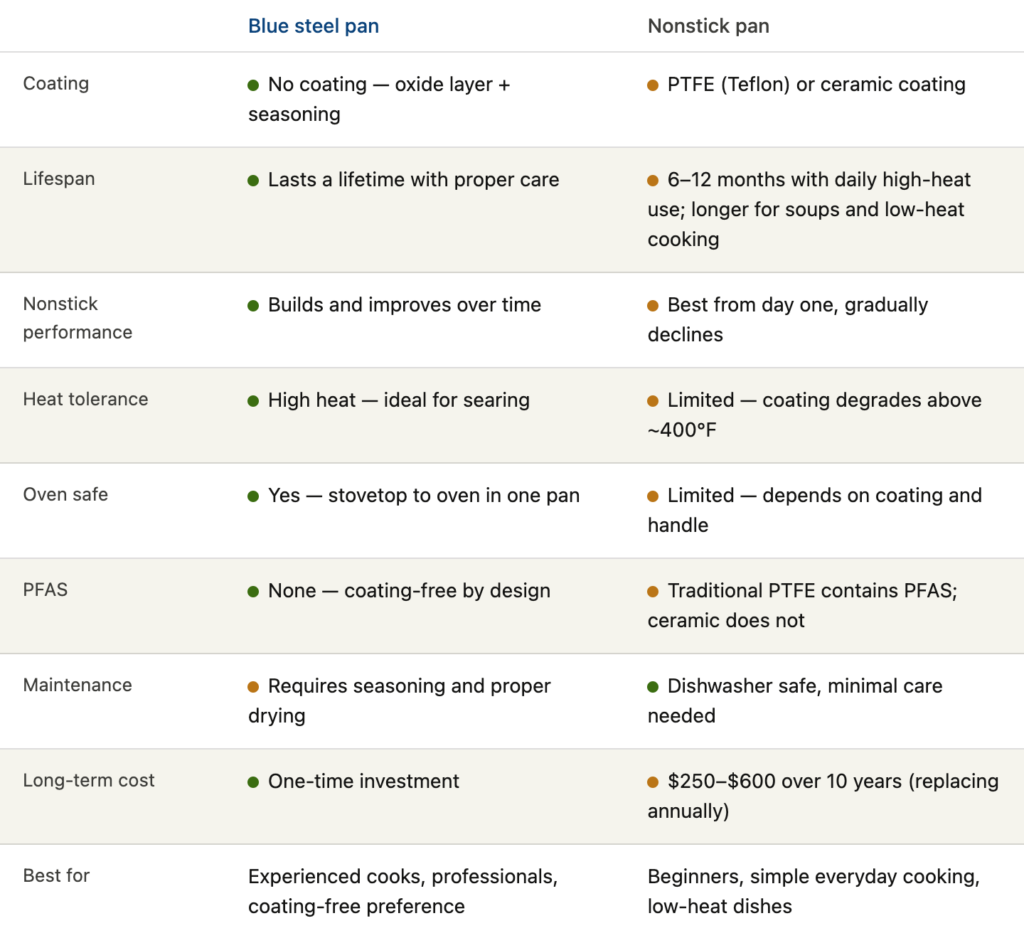
That single difference — coating vs. no coating — is what drives most of the other distinctions in the carbon steel pan vs nonstick debate.
Where Nonstick Has the Edge
It’s worth being straightforward here: nonstick pans are genuinely good at what they do, and there are real reasons people reach for them.
- Effortless out of the box — no seasoning, no preparation required. You buy it, you cook with it.
- Forgiving for beginners — eggs, fish, and delicate foods are easier to manage when you’re still learning heat control.
- Easy to clean — a quick wipe is usually all it takes.
- Lower upfront cost — a decent nonstick pan costs $40–$60, which is accessible for most people.
For low-heat, everyday cooking — scrambled eggs in the morning, reheating leftovers — a nonstick pan does the job well.
Where a Blue Steel Pan Pulls Ahead
It gets better the more you use it. This is the biggest difference in practice. A nonstick pan starts at its best and gradually declines. A blue carbon steel pan takes a few sessions to break in, but after that it keeps improving — the more you cook with it, the better the nonstick surface gets.
No coating means no coating problems. There’s nothing on the surface to chip, flake, or degrade. The pan you’re cooking on is the same pan underneath — just steel, with a natural oxide layer and seasoning. That’s it.
It handles high heat properly. Most nonstick pans are rated safe up to around 400°F, and pushing beyond that risks damaging the coating. A blue steel pan can handle significantly higher temperatures without any issue, which makes it a much better option for searing meat or getting a proper crust on anything.
Stovetop to oven in one pan. Because there’s no coating to worry about, a blue steel pan goes straight from the stovetop into a hot oven. No transferring, no extra dishes.
The Real Cost of a Nonstick Pan
This is where the carbon steel pan vs nonstick comparison gets interesting — and where most people underestimate what nonstick actually costs them over time.
Nonstick pan lifespan depends a lot on how you use it. For soups, low-heat cooking, or occasional use, the coating can hold up reasonably well for a few years. But if you’re cooking with it daily — searing, sautéing, high-heat cooking — the nonstick surface typically starts to degrade within 6 to 12 months. Once the coating starts to go, food begins sticking more, and most people replace the pan rather than keep cooking on a damaged surface.
At $50–$60 per pan, replacing it every year adds up quickly:
- 3 years → $150–$180
- 5 years → $250–$300
- 10 years → $500–$600
A blue carbon steel pan, maintained properly, lasts indefinitely. It’s a one-time investment that pays for itself relatively quickly — and unlike a nonstick pan, it doesn’t ask you to replace it.
The Health and Regulation Question
This is something more and more people are paying attention to, and it’s worth addressing directly.
Traditional nonstick coatings — particularly those containing PFAS (per- and polyfluoroalkyl substances) — have come under increasing scrutiny. Both the FDA in the United States and regulatory bodies in Europe have been moving toward stricter guidelines on PFAS, and a growing number of countries are following suit. The overall direction is clear: regulators and consumers alike are shifting away from PFAS-containing cookware.
The cookware industry’s response has largely been to move toward ceramic coatings as a PFAS-free cookware alternative — but ceramic is still a coating, and it still wears down over time.
A blue steel pan doesn’t have this problem at all. There’s no coating, no PFAS — just steel, treated and seasoned. The surface is just steel — treated, seasoned, and used.
Who Should Use Which
In the blue steel pan vs nonstick debate, the right answer really depends on who’s cooking.
A nonstick pan makes sense if:
- You’re new to cooking and want something ready to use from day one, with no preparation needed
- You want cooking to be as simple and low-maintenance as possible
- You cook mostly low-heat dishes — eggs, fish, reheating
- You’re not concerned about coatings and don’t mind replacing the pan every year or two given the nonstick pan lifespan with regular use
A blue steel pan makes sense if:
- You prefer cooking without any coating on your pan
- You have solid cooking experience and are comfortable managing heat
- You’re a professional or semi-professional cook looking for reliable, high-performance cookware
- You do a lot of high-heat cooking — searing meat, getting a proper crust
- You want to buy once and not think about replacing cookware again
When you look at the full picture, the carbon steel pan vs nonstick comparison comes down to this: the blue carbon steel pan is the better long-term investment. The nonstick pan is easier on day one. The blue steel pan is easier on day 300.
Final Thoughts
Both pans deal with the sticking problem — just in very different ways, and with very different results over time. A nonstick pan is convenient now. A blue steel pan vs nonstick isn’t really a fair fight once you factor in lifespan, performance at high heat, and the total cost over a few years.
If you’re cooking every day and want a pan that gets better over time rather than one you need to replace, the blue steel pan is worth making the switch.
Part of our blue steel pan guide: