
Honeycomb tri-ply cookware has become increasingly visible in retail stores, online marketplaces and private-label cookware ranges.

From the outside, many honeycomb frying pans look similar. They may all have a stainless steel exterior, a patterned cooking surface and a long metal handle. However, products with a similar appearance can differ considerably in body construction, thickness, weight, coating, cooking performance and production consistency.
If you would like to understand the construction first, read our guide to how honeycomb tri-ply cookware works.
For B2B buyers, the question is therefore not simply whether honeycomb cookware is popular.
The more useful question is:
Which honeycomb tri-ply cookware specification is suitable for your target market, retail position and customer expectations?
The right answer depends on how the product will be sold, how consumers are expected to use it and which specifications must be protected during mass production.
Start with the Target Market, Not the Product Appearance
Before selecting a honeycomb pattern or handle, buyers should first define the intended market position.
A cookware range developed for an entry-to-mid-level online market may require a different balance of weight, coating and packaging from a range intended for specialist kitchenware stores or premium retail programs.
Important questions include:
- What is the intended retail price?
- Will the product be sold online or in physical stores?
- Is the product positioned as a frying pan, wok or complete cookware range?
- Which sizes are already familiar to consumers in the target market?
- Is easy food release the main selling point?
- Is browning and searing performance more important?
- Does the buyer require a PFAS-free coating strategy?
- Will consumers expect dishwasher or oven-safe claims?
- Is induction compatibility essential?
- How important are product weight and shipping cost?
These decisions influence the construction of the product.
For example, a heavier pan may create a more substantial and premium impression, but it also increases material cost, shipping weight and handling effort.
A lighter pan may be easier to use and more suitable for online sales, but it still needs enough structural stability to remain flat during heating.
There is no single specification that is automatically suitable for every market.
Confirm What the Cookware Body Is Actually Made Of
The terms honeycomb, tri-ply and fully clad describe different characteristics of the product.
They should not be used as if they mean the same thing.
Honeycomb
Honeycomb describes the patterned cooking surface.
In coated hybrid cookware, raised stainless steel areas are combined with recessed areas containing a non-stick coating.
The pattern may help protect part of the coating from direct contact with utensils, while still allowing some stainless steel contact for browning.
Tri-Ply
Tri-ply describes a body made from three bonded metal layers.
A common construction is:
- Food-contact stainless steel inner layer
- Heat-conductive aluminum core
- Magnetic stainless steel exterior
For many induction-compatible products, a typical combination is 304 stainless steel, aluminum and 430 stainless steel.
However, buyers should still confirm the actual material specification rather than relying only on the words “tri-ply.”
Fully Clad
In a fully clad tri-ply frying pan, all three bonded metal layers extend continuously from the base through the side walls and up to the rim.
This means that the aluminum core is present throughout the complete cookware body rather than being limited to an additional disc attached only to the bottom.
The continuous layered construction helps distribute heat across both the base and side walls and does not require a separate capsule bottom.
Buyers should confirm the fully clad construction through the material specification or a cross-section of the cookware body.
Select the Right Frying Pan Sizes for the Market
The best size range is not necessarily the same for every market.
A useful starting point is to review which aluminum non-stick frying pan sizes already sell well in the destination market.
Although the construction is different, established aluminum cookware sales can provide a practical reference for local cooking habits and preferred pan diameters.
In many markets, 24cm is one of the more widely accepted everyday frying pan sizes.
Buyers introducing honeycomb tri-ply cookware for the first time may begin with one or two core sizes instead of launching a complete range immediately.
This reduces the initial inventory risk and makes it easier to evaluate the market response.
However, buyers should not select sizes based only on diameter.
A honeycomb tri-ply frying pan is generally heavier than an aluminum non-stick frying pan of the same size. This difference becomes more noticeable as the diameter increases.
If the primary consumer group includes users who prefer lighter and easier-to-handle cookware—often an important consideration for ranges marketed to female home cooks—the finished weight should be evaluated carefully.
For example, a 28cm frying pan provides greater cooking capacity, but it may feel too heavy when combined with a thick tri-ply body and a cast stainless steel handle.
In this situation, a 26cm frying pan may provide a better balance between cooking capacity and handling.
Important size-selection factors include:
- Popular aluminum non-stick pan sizes in the local market
- Typical household size and cooking style
- Finished weight of the tri-ply pan
- Handle type and balance
- Online shipping weight
- Retail shelf positioning
- Whether the pan will be sold individually or as part of a set
The frying pan is often a practical starting point for a new honeycomb cookware program because it clearly demonstrates the patterned surface and cooking performance.
A brand with an established cookware range may later add woks, sauté pans, casseroles or coordinated cookware sets.
Choose the Body Thickness for the Target Price Level
Honeycomb tri-ply cookware is available in different body thicknesses.
As a practical market reference:
- Below 2.0mm is generally used for more price-sensitive or entry-level products
- Around 2.0–2.5mm is commonly used for mid-market cookware
- Above 2.5mm is more commonly associated with higher-end positioning
These ranges are not absolute quality rules because final performance also depends on material quality, bonding, forming and production control.
However, they provide buyers with a useful starting point when comparing quotations and samples.
In a typical tri-ply structure, the stainless steel layers often remain within a relatively stable thickness range. The main difference between a 2.0mm and a 2.5mm body therefore usually comes from the thickness of the aluminum core.
A thicker aluminum core adds material, increases product weight and affects its heating and heat-retention characteristics.
For most mainstream household markets, a total body thickness of approximately 2.0–2.5mm provides a practical balance between:
- Heat distribution
- Product stability
- Finished weight
- Retail positioning
- Material cost
- Consumer handling
A specification above 2.5mm may be appropriate for a more premium cookware range, but buyers should also consider the additional weight—particularly for 28cm frying pans, deep sauté pans and woks.
Thickness should therefore be selected together with the product diameter, depth, handle and target finished weight.
When comparing samples, buyers should ask the supplier to confirm:
- Total tri-ply body thickness
- Thickness of each individual layer
- Aluminum-core thickness
- Finished product weight
- Acceptable production tolerance
This is more useful than comparing only one advertised thickness number.
Evaluate the Honeycomb Pattern as a Functional Detail
The honeycomb pattern is not only a visual decoration.
Its design can influence food contact, coating coverage, cleaning and the overall appearance of the cookware.
Buyers should consider:
- Pattern size
- Pattern density
- Raised stainless steel area
- Recessed coated area
- Pattern depth
- Coverage across the cooking surface
- Consistency from the center to the edge
- Transition between the patterned surface and the rim
- Pattern alignment between different sizes
A very large or open pattern may expose more stainless steel to the food. This can support browning but may also require more cooking oil and better heat control.
A denser pattern may provide more coated contact area, but the visual effect and cleaning experience will be different.
The correct balance depends on the intended cooking performance and market message.
For an OEM honeycomb cookware range, the pattern can also become part of the brand identity.
Buyers may choose an established pattern for a faster launch or develop a more distinctive surface design when the order volume and development plan support it.
However, a unique-looking pattern is only valuable when it can be produced consistently across different sizes and production batches.
Choose the Coating According to the Destination Market
The choice between PTFE and ceramic coating depends partly on the destination market and the buyer’s own product policy.
For US programs, ceramic coating has become a common option when the brand or retailer requires a PFAS-free product position.
In Europe, the situation varies between countries, retailers and individual buyers.
Some European markets continue to accept both PTFE and ceramic coating, while buyers in markets such as Denmark may already treat PFAS-free coating as an important sourcing requirement.
Buyers should therefore confirm both the current market requirement and their future coating strategy before approving the product.
PTFE-Based Coating
PTFE coating is still used in many markets because it normally provides reliable food release and familiar cooking performance.
When PTFE is selected, buyers should confirm:
- Coating system and supplier
- Number of layers
- Food-contact documentation
- PFOA and other applicable regulatory requirements
- Recommended cooking temperature
- Abrasion performance
- Care instructions
A PFOA-free claim should not be presented as the same as a PFAS-free claim.
PFAS-Free Ceramic Coating
Ceramic coating is more suitable when the market, retailer or brand requires a PFAS-free position.
However, the coating should not be selected according to the claim alone.
Buyers should also evaluate:
- Initial food release
- Abrasion resistance
- Performance after repeated use
- Heat resistance
- Color consistency
- Care requirements
The coating used in honeycomb cookware should have suitable abrasion resistance.
Consumers often expect a honeycomb surface to provide better utensil resistance and greater durability than a conventional smooth non-stick coating.
The raised stainless steel pattern may partially protect the coating in the recessed areas, but it does not remove the need for a durable coating system.
Coating adhesion, abrasion performance and application consistency should therefore be checked during sample evaluation.
Metal-utensil, dishwasher-safe and long-life claims should only be used when they are supported by the selected coating system and agreed testing.
Choose Between a Cast and Hollow Stainless Steel Handle
For honeycomb tri-ply frying pans, the two most common handle directions are cast stainless steel and hollow stainless steel.
The appropriate choice depends largely on the target price and product position.
Cast Stainless Steel Handle
A cast stainless steel handle provides a more substantial appearance and feel.
It is generally:
- More expensive
- Heavier
- More suitable for premium positioning
- Able to create a stronger visual connection with high-end clad cookware
However, its additional weight must be considered together with the tri-ply body.
A thick 28cm frying pan combined with a heavy cast handle may look premium but can become less comfortable to lift and control.
Hollow Stainless Steel Handle
A hollow stainless steel handle is generally:
- Lighter
- More cost-effective
- Suitable for mainstream and competitively priced ranges
- Slower to transfer heat than a solid cast handle of a similar design
A well-designed hollow handle can still provide a clean stainless steel appearance while reducing both cost and total product weight.
It is therefore not simply a lower-quality option.
For many mid-market programs, a hollow stainless steel handle may provide a more practical balance between appearance, handling and price.
When Should a Helper Handle Be Considered?
A helper handle can be considered for:
- Frying pans of 28cm or above
- Deep frying pans
- Sauté pans
- Large woks
- Products with a heavier body and cast handle
Whether it is necessary depends on the final product weight and how the cookware will be used.
A helper handle increases material and assembly cost, but it can make a large pan easier and safer to lift when it contains food.
The buyer should therefore evaluate the complete assembled sample rather than deciding based only on diameter.
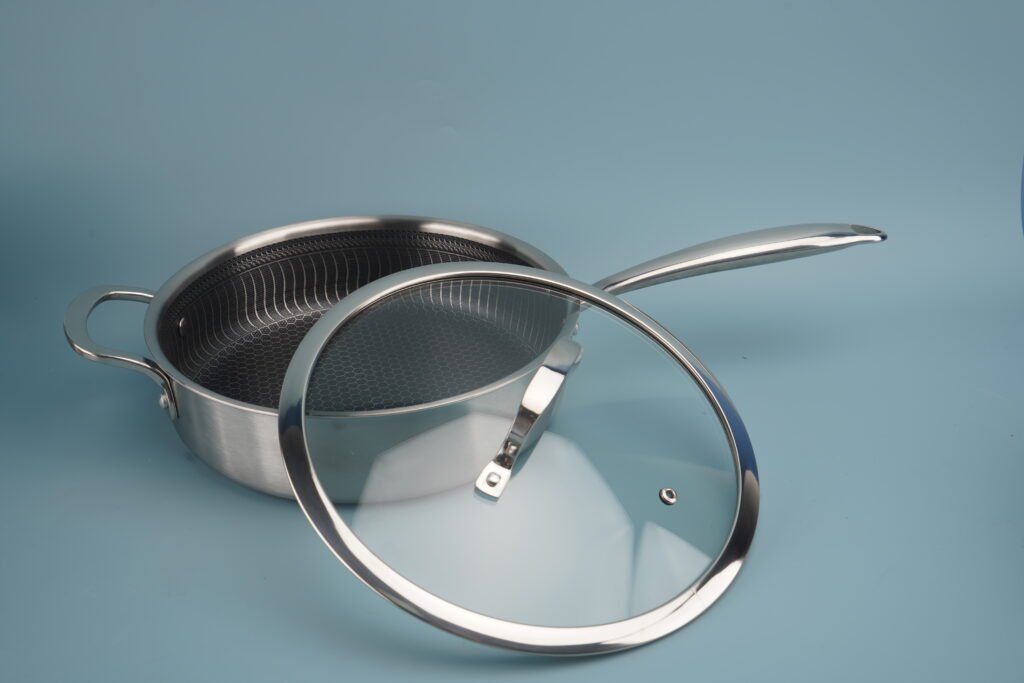
Choose the Surface Finish for the Cookware Body and Handle
Surface finish is another important specification because it affects the product appearance, market position and price.
The finish should be confirmed separately for the cookware body and the stainless steel handle.
Mirror Polish
A mirror-polished surface has a bright, highly reflective appearance similar to a mirror.
It gives the cookware a more polished and premium presentation, but it generally requires additional polishing work and costs more than a satin finish.
Mirror-polished surfaces can also make fingerprints, polishing marks and small scratches more visible. Buyers should therefore check the consistency of the finish carefully during sample approval and mass production.
Satin Finish
A satin finish has a softer and less reflective appearance.
It is generally more cost-effective than mirror polishing and can be easier to maintain visually during everyday use.
The cookware body and handle do not necessarily need to use the same finish. For example, a buyer may select a mirror-polished body with a satin-finished handle or use the same finish across the complete product.
The final specification should clearly state:
- Cookware body finish: mirror or satin
- Handle finish: mirror or satin
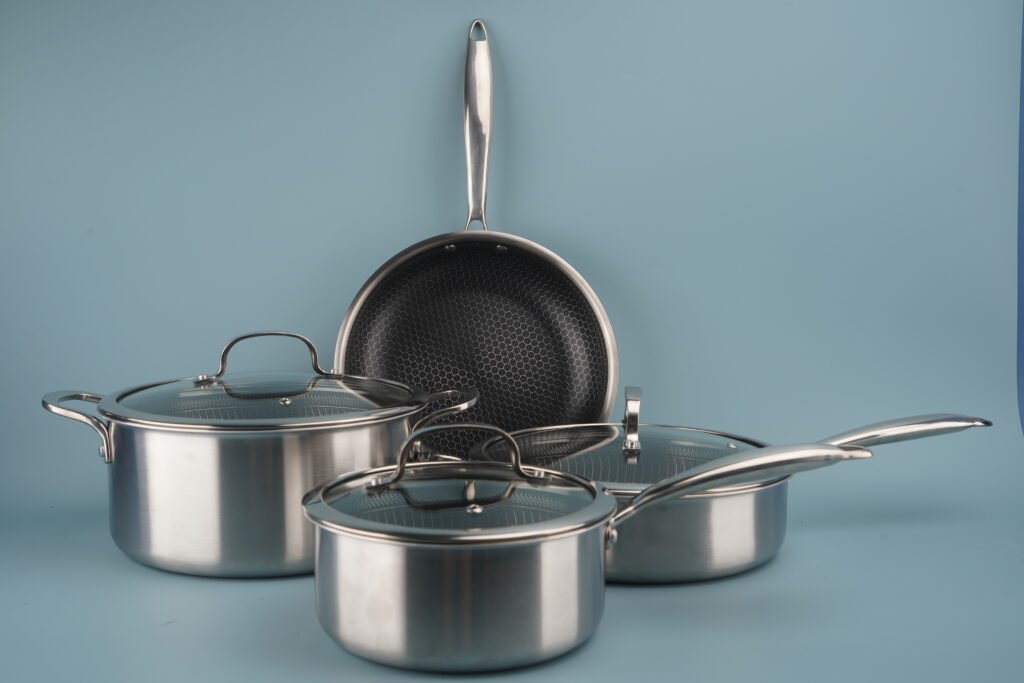
Check Induction Performance and Base Flatness
A magnetic stainless steel exterior allows a tri-ply frying pan to work on induction cooktops, but buyers should not stop at the statement “induction compatible.”
The sample should be tested on the intended cooker types.
Important points include:
- Induction recognition
- Heating response
- Contact between the pan and the cooktop
- Base flatness
- Stability during heating
- Condition after repeated heating and cooling
- Compatibility with common cooker sizes in the target market
Base flatness should be checked both before and after heating.
A frying pan that appears flat at room temperature may behave differently after thermal cycling.
Product diameter, material thickness, forming control and stress inside the bonded body can all affect the final result.
For a full-clad frying pan, the quality of the bonded material and the forming process is therefore as important as the external appearance.
How Should Buyers Evaluate a Sample?
A good-looking sample is important, but appearance alone is not enough to approve mass production.
A buyer evaluating a honeycomb tri-ply frying pan should check the complete product.
Body Construction
- Confirm the material layers
- Measure the stated body thickness
- Record the finished product weight
- Check the diameter, depth and rim shape
- Confirm that the body is fully clad if this is part of the specification
Honeycomb Surface
- Check pattern consistency
- Compare the center and edge areas
- Look for incomplete or uneven pattern sections
- Confirm the intended coating coverage
- Check the transition around the rim
Coating
- Confirm the coating type and documentation
- Inspect color and gloss consistency
- Check for pinholes, scratches or uneven application
- Perform the agreed food-release and adhesion tests
- Confirm the care and temperature limitations
Base and Heating
- Check room-temperature flatness
- Test induction recognition
- Evaluate heating consistency
- Recheck flatness after heating and cooling
Handle and Accessories
- Check handle alignment and balance
- Test rivet or connection strength
- Evaluate handle temperature
- Confirm the fit of any lid or accessory
- Check whether the product remains comfortable to lift when full
Appearance and Packaging
- Confirm the specified mirror or satin finish on the cookware body and handle
- Check polishing consistency across the product range
- Confirm logo position and clarity
- Inspect the rim and edges
- Test whether the packaging protects the polished surface
- Confirm barcode, care instructions and required market labels
A simple egg test may demonstrate initial food release, but it does not confirm long-term coating performance, body stability or mass-production consistency.
What Can Be Customized?
Depending on the product and order program, customization may include:
- Body thickness and finished weight
- Honeycomb pattern and coverage
- PTFE or ceramic coating
- Interior coating color
- Handle style and finish
- Glass or stainless steel lid types and options
- Cookware body finish: mirror or satin
- Logo method and position
- Retail packaging, including gift boxes, half gift boxes, color sleeves, PDQ displays, hangtags and other formats
- Care instructions
- Set combinations
- Testing and labeling requirements
Not every element requires a completely new design.
For buyers testing the market, using an established body shape with a customized coating, handle, logo and packaging can reduce development time and initial risk.
A more distinctive surface design may be appropriate once the market direction and expected order volume are clearer.
Mass-Production Consistency Matters
Approving one sample does not complete the sourcing process.
The final specification should record the details that must remain consistent during production, including:
- Material construction
- Body thickness
- Product weight and tolerance
- Dimensions
- Honeycomb pattern
- Coating system and color
- Handle and accessories
- Cookware body and handle finish
- Flatness requirement
- Logo
- Packaging
- Testing and inspection method
A retained approval sample can be used as a visual and functional reference during production and final inspection.
For repeat-order programs, consistency is particularly important.
Changes in body weight, polishing, coating color, pattern definition or handle fit can affect how the product appears beside earlier stock.
The supplier should therefore control not only the first sample but also repeat production.
Frequently Asked Questions
Is All Honeycomb Cookware Tri-Ply?
No.
Honeycomb describes the cooking-surface pattern, while tri-ply describes the bonded metal body.
A honeycomb frying pan may use tri-ply, single-layer stainless steel, a bonded base or another construction.
Buyers should confirm both the cooking surface and the body construction.
Is Fully Clad the Same as Tri-Ply?
Not exactly.
Tri-ply means that the body uses three bonded metal layers.
Fully clad means those bonded layers extend from the base through the side walls.
A product can be both tri-ply and fully clad, but the two terms describe different characteristics.
What Is a Suitable Thickness for Honeycomb Tri-Ply Cookware?
For many mainstream household markets, a total thickness of approximately 2.0–2.5mm provides a practical balance between performance, weight and cost.
Products below 2.0mm are generally more price-oriented, while products above 2.5mm are more commonly used for higher-end positioning.
The correct thickness should still be evaluated together with the pan size and finished weight.
Is a Honeycomb Frying Pan Completely Non-Stick?
It should not be treated in exactly the same way as a conventional smooth non-stick frying pan.
The raised stainless steel pattern creates direct food contact in some areas, while the recessed coating supports food release.
Cooking temperature, preheating and oil use still affect performance.
Is PTFE or Ceramic Better for Honeycomb Cookware?
Neither coating is automatically the best option for every market.
PTFE is often selected for reliable food release.
Ceramic may be chosen when the buyer, retailer or destination market requires a PFAS-free position.
The decision should reflect performance, market requirements, price and care instructions.
Can Metal Utensils Be Used?
The raised stainless steel pattern may provide some protection to the recessed coating, but metal-utensil claims should depend on the actual surface design, coating system and testing.
It is better to confirm the claim for the specific product rather than assume that every honeycomb pan is metal-utensil safe.
Final Thoughts
Choosing honeycomb tri-ply cookware for a market requires more than comparing patterns and prices.
Buyers should evaluate:
- Target market and retail position
- Tri-ply and fully clad construction
- Product sizes
- Thickness and finished weight
- Honeycomb pattern
- Coating system
- Handle construction
- Cookware body and handle finish
- Induction performance
- Sample testing
- Mass-production consistency
A suitable honeycomb tri-ply frying pan should balance cooking performance, handling, appearance, compliance and commercial cost.
For buyers with a complete product specification, the project can be developed according to the stated requirements.
For buyers who begin with only a market idea, target size or reference sample, the supplier should also be able to recommend practical structural and technical details.
Contact us to discuss the target market, product specification and customization options for your honeycomb tri-ply cookware range.