
Developing custom die cast aluminum cookware starts with understanding what needs to change. Some projects require a different coating color and branded packaging. Others involve adjustments to an existing cookware body or a completely new mold.
For cookware brands and importers, identifying the right development approach helps clarify the investment and work involved. Whether the project is a single frying pan or a coordinated collection, there are three main routes: customization using existing molds, modification of an existing mold, and new mold development.
1. What Can Be Customized Using Existing Cookware Molds?
An existing mold can provide a practical starting point when the cookware body already meets the required dimensions, shape, and capacity.
For private label cookware projects, customization options typically include:
- Interior coating type and color.
- Exterior color and finish.
- Brand marking, with the method and location confirmed separately.
- Packaging design.
- Handle color, depending on the material and finish.
These options allow buyers to create a coordinated brand appearance while retaining an established cookware body.
Nonstick Coating Options
The coating is an important part of a die cast aluminum nonstick cookware project. Buyers may consider PTFE-based nonstick coatings or ceramic coatings according to their product positioning, performance expectations, and destination-market requirements.
The specific coating system, available colors, supporting documentation, and testing requirements should be confirmed during development.
Handle Styles Need Individual Confirmation
Handle styles are not always freely interchangeable. For die cast aluminum cookware, the handle attachment must match the connection structure of the pan body, so the range of compatible handles may be limited.
Changing the handle color may be possible without changing its structure. However, a different handle shape or attachment needs a compatibility review and may require additional development.
2. When Can an Existing Mold Be Modified?
Some changes to the cookware body can be evaluated for modification of an existing mold rather than completely new tooling.
Depending on the mold construction and the extent of the requested change, these may include:
- The induction plate diameter and corresponding base area.
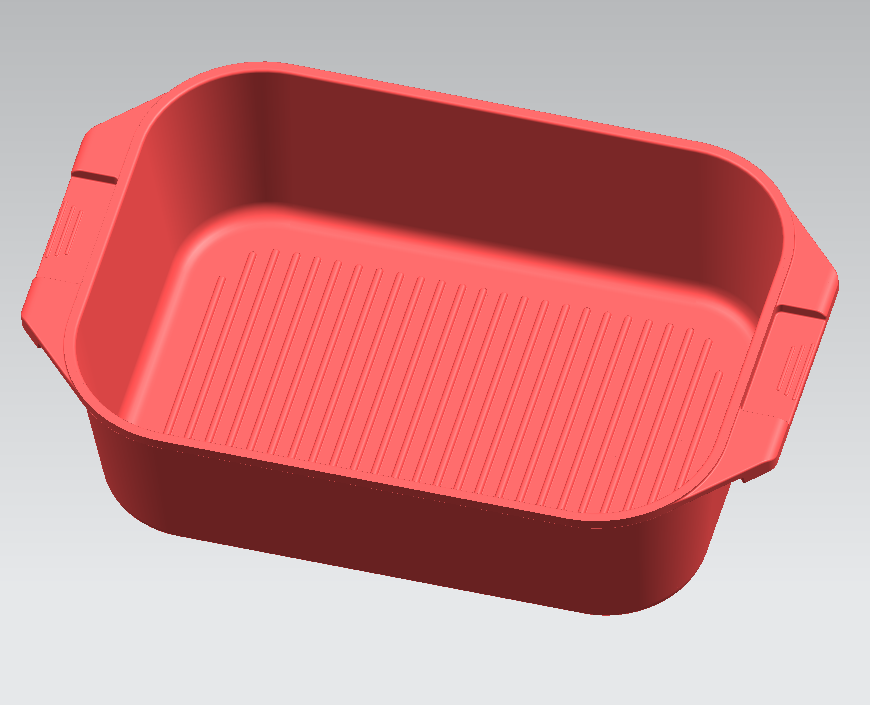
- Raised ribs on the interior cooking surface.
- Local changes to the appearance of integral cast side handles.
- Base thickness.
- Molded patterns or textures on selected areas of the body.
These possibilities need to be assessed individually. A modification that is practical for one mold may not be suitable for another.
For example, a buyer may be satisfied with a pan’s overall dimensions and shape but want to add interior ribs. Reviewing the existing mold helps determine whether this can be achieved and how the modification would affect the finished weight, unit price, and development schedule.
Explore Available Die Cast Aluminum Cookware Designs
Browse our nonstick cookware collection for examples of existing die cast aluminum cookware designs. To check available molds, sizes, and customization options for your project, contact us with your requirements.
3. When Is a New Cookware Mold Needed?
A new mold is generally required when changes affect the main dimensions or overall form of the cookware body.
Typical examples include:
- A new diameter or overall size.
- A different body depth.
- A new body profile or overall shape.
A familiar-looking pan in a different size should not automatically be treated as a minor mold adjustment. Changes to diameter or depth affect the body geometry and usually require a separate mold.
New cookware mold development can support a single product or a complete collection. A buyer may need only one extra-large shallow casserole, specialized frying pan, or grill pan. Developing a full series is not a prerequisite for a custom project.
4. What Order Quantity Makes New Mold Development Worth Considering?
New mold development represents a significant investment. Buyers should consider the initial order quantity, tooling costs, and realistic prospects for repeat orders before proceeding.
For projects requiring a completely new cookware body mold, we generally recommend an initial order of at least 5,000 units per model, per size. A 28 cm casserole, for example, would be assessed separately from other sizes in the same collection.
This is our recommended starting point for evaluating a project, rather than a universal industry minimum. The appropriate quantity depends on the tooling investment and the buyer’s sales plan.
Example: Tooling Investment for a 28 cm Casserole
Based on our development experience, a new mold for a 28 cm die cast aluminum casserole may cost approximately RMB 100,000–130,000, or roughly USD 15,000–20,000, depending on the design. Development of matching accessories, where required, may add another RMB 20,000–30,000, or USD 3,000 – 4500 approx.
Using these figures, the combined development investment would be approximately RMB 120,000–160,000, or USD 18,000 – 24,000 approx. If allocated entirely to an initial order of 5,000 units, this represents USD 3.5– 5 per unit in development costs alone, separate from manufacturing costs.
Repeat orders can spread this investment across a larger total volume. However, an initial quantity of 5,000 units does not automatically make every new mold project commercially suitable.
If the initial quantity is smaller or demand is still uncertain, an existing mold—or a suitable modification to one—may offer a more practical starting point.
These figures are indicative estimates. Actual costs depend on the specific design, and USD equivalents vary with the exchange rate.
5. Confirm Specifications and Drawings Before Mold Making
Before a new mold is made, the product requirements need to be developed into a clear, agreed design.
The main details to confirm include:
- Dimensions: Diameter or length and width, body height, and other critical measurements.
- Target weight: The buyer’s target must be assessed alongside the body dimensions, thickness distribution, and structural requirements. Weight cannot be reduced indefinitely without compromising the suitability of the design, while a heavier body increases material usage and can raise the unit price. The final agreed weight should balance the buyer’s target, structural feasibility, and cost. It should also be clear whether this refers to the body alone or the complete product with its lid and accessories.
- Body construction: Base and wall thicknesses, rim details, and other structural features.
- Capacity: The required capacity and how it will be measured.
- Accessory fit: Compatibility between the cookware body and its accessories, including lids, handles, knobs, and attachment hardware.
- Appearance: Overall profile, integral handles, surface patterns, and other visible details.
These requirements should be reviewed together. Adjusting body depth affects capacity, while changing thickness affects weight and cost.
The agreed specifications are then reflected in the technical drawings. Mold making begins after the drawings have been reviewed and approved by both parties.
6. Check Trial Samples Against the Approved Design
After the mold is completed, trial samples are checked against the approved drawings and specifications.
This review covers actual dimensions, weight, capacity, accessory fit, and appearance. It also provides an opportunity to assess handling and confirm whether adjustments are needed.
Once the body design is confirmed, finished samples can be reviewed for coating, color, branding, and overall presentation. Relevant performance and compliance testing should also be agreed for the intended product and market.
For a step-by-step overview of how the cookware is made, see our guide to the die cast aluminum cookware manufacturing process.
7. Custom Die Cast Aluminum Cookware: Two Project Examples
Case 1: Adding Interior Ribs to an Existing Product
A supermarket customer wanted to add raised ribs to the interior cooking surface of an existing cookware model based on end-user feedback.
We assessed the feasibility of modifying the existing mold and clarified the impact on the unit price and cookware body weight. After the customer confirmed the proposal, we provided updated drawings within two days for approval before proceeding with the mold modification.
The revised cookware was successfully produced and delivered.
Case 2: Developing an Extra-Large Shallow Casserole
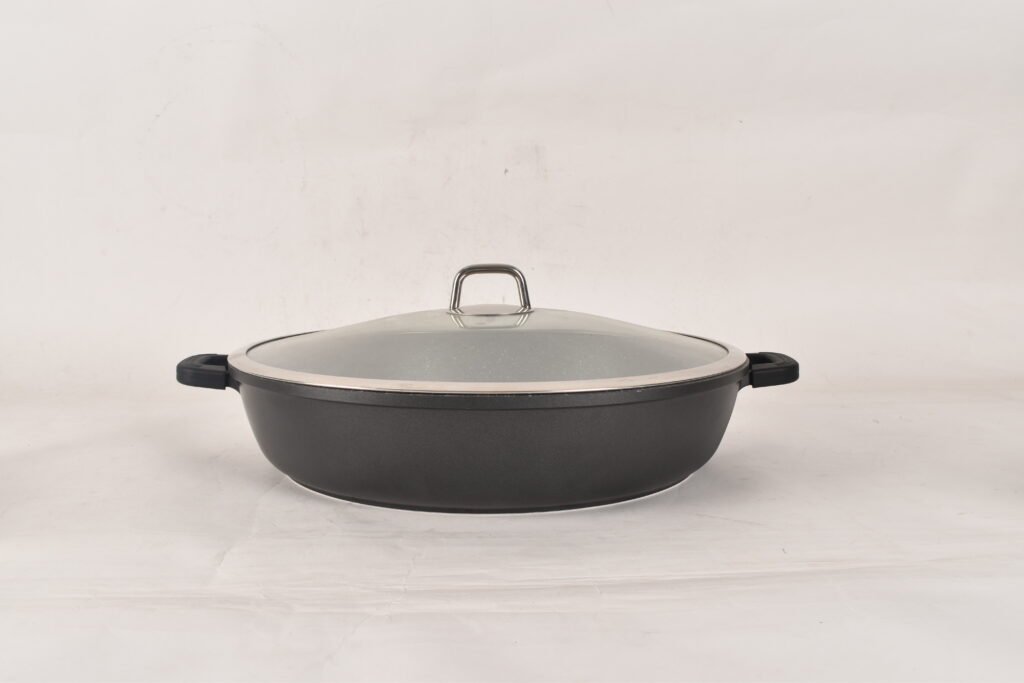
An importer needed a new extra-large shallow casserole requiring a new cookware mold.
We supported the project through tooling development and production, completing the new mold and delivering the order within 60 days.
The project covered a single cookware model, showing how custom development can address a specific size requirement without requiring a complete new collection.
The 60-day timeframe reflects this particular project. Other schedules depend on design requirements, approvals, and production arrangements.
Develop Custom Die Cast Aluminum Nonstick Cookware with CHINCHIN
At CHINCHIN, we focus on supplying die cast aluminum nonstick cookware for brands and importers, with support for private label customization and product development.
We help assess whether a project can use an existing mold, requires mold modification, or needs new tooling. We also coordinate specification review, drawing confirmation, sampling, and production follow-up with our manufacturing partners.
If you are developing a custom frying pan, casserole, grill pan, or cookware collection, contact us with your reference images, target specifications, and intended changes. We can help review the development options for your project.